Choosing an affiliate product isn’t as simple as finding one with a high commission and adding its link to your website. The product needs to make sense for your audience, fit your niche, offer genuine value, and give people a reason to buy.
A product can have an attractive commission rate and still generate very little revenue if there’s no demand for it or if it doesn’t match what your audience is looking for. That’s why product selection should be based on more than just how much you can earn from each sale.
So, how do you choose affiliate products that actually convert?
In this guide, you’ll learn how to select profitable affiliate products that align with your audience and niche, evaluate their demand and conversion potential, and choose products that are worth promoting.
Why Choosing the Right Affiliate Products Matters
Not every product is worth promoting, even if it offers an attractive commission. The right product should match your audience’s needs, fit naturally into your content, and provide enough value to justify the purchase.
When you choose products carefully, you’re not just improving your chances of earning commissions. You’re also building trust with your audience and creating content around products you can confidently recommend.
So, before you commit your time and content to an affiliate offer, start choosing the right products first.
1. Start With Your Target Audience
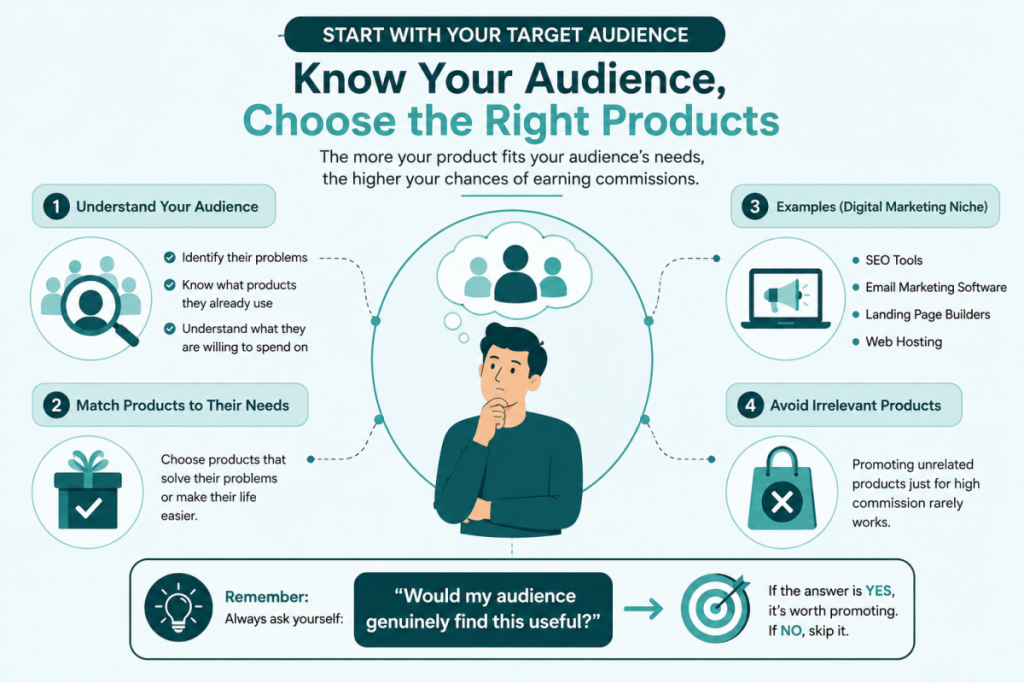
Before you search for affiliate products to promote, you need to understand who you’re promoting them to.
Think about the problems your audience is trying to solve, the products they are already using, and what they might be willing to spend. If you understand these things, choosing relevant products becomes much easier.
For example, if you run a digital marketing website, your audience might be interested in SEO tools, email marketing software, landing page builders, or web hosting. Promoting an unrelated product simply because it offers a high affiliate commission probably won’t work nearly as well.
When choosing products, always ask one question first:
“Would my audience genuinely find this useful?”
If the answer is no, the product probably isn’t worth promoting.
2. Look for Products With Buying Intent
Not every visitor is ready to buy.
Someone searching for “what is email marketing” is probably looking for information. Someone searching for “best email marketing software” is much closer to making a purchasing decision.
That’s why pay attention to buying intent when choosing affiliate products.
Look for topics such as:
Best [product]
[Product] review
[Product] alternatives
[Product] vs [competitor]
[Product] pricing
Best [product] for [specific audience]
These searches often indicate that someone is already researching their options. If you can introduce the right product at that stage, you have a much better opportunity to generate a conversion.
3. Never Ignore Product Quality
A product can have an excellent commission rate and still be a terrible affiliate product.
Before you promote something, check its features, customer reviews, support quality, refund policy, and overall reputation. If possible, try the product yourself.
Your audience trusts your recommendations. If you repeatedly send them toward poor-quality products just because they pay well, you can lose that trust very quickly.
This is particularly important when you’re building a long-term affiliate website. One commission isn’t worth damaging your credibility.
4. Check the Product Data Before You Promote It
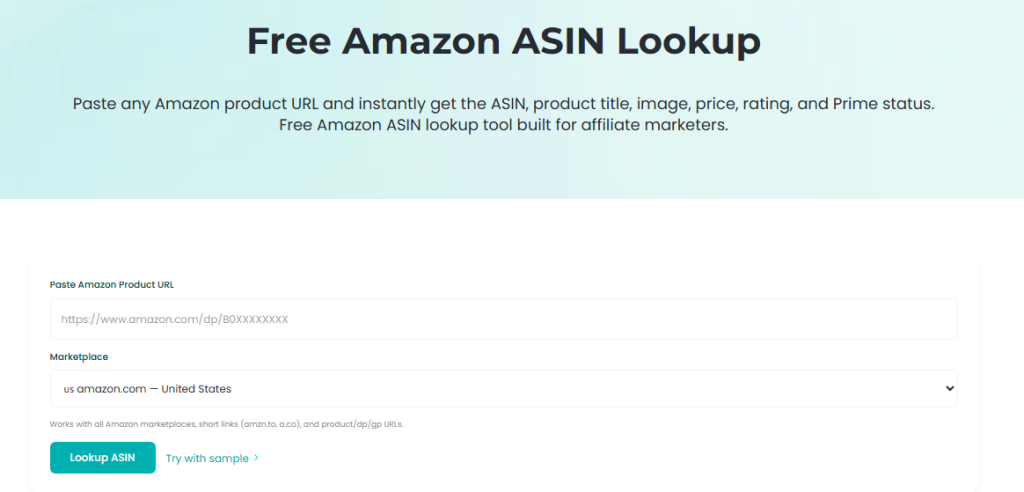
If you’re choosing Amazon affiliate products, take a closer look at the product data before deciding whether it’s worth promoting. Price, ratings, review count, and Prime eligibility can give you useful signals about how established a product is and how shoppers might perceive it.
An ASIN lookup tool can make this research easier. Just enter the Amazon product URL to retrieve its ASIN and key product information in one place. This is especially helpful when you’re researching multiple products and want to compare them before choosing which ones to promote.
For example, if two similar products have a similar price but one has thousands of reviews and a stronger rating, that may be a useful signal when deciding which one deserves more attention.
Of course, these numbers don’t guarantee conversions. You still need to consider audience fit, buying intent, product quality, competition, and the overall buying experience before making your final choice.
5. Check Market Demand
Even a great product won’t generate many sales if people aren’t interested in buying it.
Before choosing an affiliate product to promote, check whether there is consistent demand for it. You can look at search trends, keyword volume, competitor content, marketplace activity, customer reviews, and discussions around the product or category.
You don’t necessarily need to choose products with massive search volume. A product with a smaller but highly targeted audience can be more profitable than a popular product that attracts plenty of attention but little buying intent.
For physical products, look at things like sales activity, review volume, ratings, price changes, and whether similar products are consistently being recommended. For digital products and services, you can also look at search interest, customer feedback, competitors, and how actively the product is being promoted.
Product Type
What to Check
Useful Demand Signals
Physical products
Sales activity, reviews, ratings, pricing
Consistent sales, high review volume, strong ratings
Digital products
Search interest, competitors, customer feedback
Growing searches, active communities, positive reviews
You can also consider evergreen affiliate products that people are likely to need throughout the year. This could be anything from kitchen appliances and fitness equipment to skincare products, books, online courses, software, or web hosting. Evergreen demand gives you a better chance of generating sales long after you publish the content.
At the same time, don’t completely ignore seasonal or trending products. If you can publish content at the right time and there is clear buying demand, those products can generate significant short-term revenue.
6. Don’t Choose a Product Just Because of its Commission
This is one of the easiest mistakes to make when learning how to choose affiliate products.
A 50% commission sounds great. But what matters is how much money you can actually make. Imagine Product A costs $20 and gives you a 50% commission. You earn $10 per sale. Product B costs $100 and gives you a 20% commission. You earn $20 per sale.
Now add conversion rate to the equation. If Product B converts much better, it could easily become the more profitable affiliate product despite having a lower commission percentage.
So, when comparing affiliate programs, don’t look at commission rates alone. Consider the product price, conversion rate, average order value, and when the data is available, consider earnings per click (EPC).
7. Check the Affiliate Program Terms
Once you’ve found a product you like, take a closer look at the affiliate program itself.
Check the commission structure, cookie duration , payment terms, attribution rules, and promotional restrictions.
Cookie duration is particularly important. If an affiliate program gives you credit for a sale only when someone purchases within 24 hours of clicking your link, that’s very different from a program offering a 30, 60, or 90-day cookie.
You should also check whether the program offers recurring commissions. For subscription-based products, recurring commissions can give you an opportunity to earn repeatedly from the same customer.
8. Choose Products You Can Build Content Around
Don’t choose a product simply because you can place an affiliate link somewhere on your website.
Instead, think about whether you can create useful content around it.
Could you write a detailed review? A comparison? An alternative article? A tutorial? A buying guide?
For example, if you promote a WordPress plugin, you could create content around how to use it, compare it with competitors, explain its features, and help readers decide whether it’s right for them.
The more useful content you can create around an affiliate product, the more opportunities you have to reach potential buyers.
9. Look at the Product’s Conversion Experience
Your article can convince someone to click an affiliate link, but what happens after they leave your website?
That’s something you should consider before choosing anaffiliate product.
Visit the merchant’s website yourself. Is the pricing clear? Are the benefits easy to understand? Does the product have good reviews or testimonials? Is the checkout process simple? Does the website work well on mobile?
A strong product page can make a significant difference to conversion rate.
Remember, you’re not only choosing an affiliate product. You’re choosing the entire buying experience that comes after your recommendation.
10. Start With a Few Products and Test Them
You don’t need to promote 50 products when you’re starting out.
I’d rather choose 5-10 relevant products, create genuinely useful content around them, and see what happens.
Once you start getting traffic, pay attention to clicks, conversion rate, earnings, and which articles are actually generating sales. You can then invest more time in the products that perform well and reconsider the ones that don’t.
This turns affiliate product selection from guesswork into a process based on real data.
11. Use the Right Tools to Present Your Affiliate Products
Choosing profitable affiliate products is only one part of the process. You also need to present those products clearly enough that visitors can understand their options and take action.
AffiliateX providesGutenberg blocks and Elementor widgets for creating product-focused affiliate content, including product displays, comparisons, specifications, ratings, and calls to action. It also supports integrations with Amazon, eBay, and AliExpress, depending on the feature you’re using.
For example, instead of simply placing a text link after several paragraphs, you can use a structured product display to highlight the information a buyer actually needs. AffiliateX also provides features such as dynamic product listings and product data synchronization, which can reduce the amount of manual product information you need to maintain.
The important thing though: to use the tool after you’ve chosen the right product is not to assume that a better-looking product box will make a bad product convert.
12. Replace Products That Don’t Convert
Affiliate product selection isn’t something you do once and forget about.
You may discover that a product you expected to perform well gets plenty of clicks but very few sales. Another product with a lower commission might consistently generate conversions.
When that happens, use the data to make a decision.
You can improve the article, change the call to action, test a different offer, or replace the product entirely. You should also revisit older content from time to time because prices, products, affiliate programs, and customer preferences can change.
The goal isn’t to promote as many affiliate products as possible. It’s to find the products that your audience actually responds to.
A Simple Way to Choose Affiliate Products
Before you add an affiliate product to your website, ask yourself:
Does it fit my audience?
Does it solve a real problem?
Is there enough market demand?
Would I genuinely recommend it?
Is the affiliate commission worth the effort?
Does the affiliate program have reasonable terms and cookie duration?
Does the product have a good conversion experience?
Can I create useful content around it?
If most of your answers are yes, the product is probably worth testing.
Final Thoughts
Learning how to choose affiliate products isn’t about finding the affiliate program with the highest commission. It’s about finding the right combination of audience fit, product quality, market demand, buying intent, and conversion potential.
Start with your audience. Find products that solve their problems. Check the product and brand carefully, compare the affiliate program terms, and don’t ignore the conversion experience.
Then test your choices and let the data guide you.
Once you know which affiliate products actually work for your audience, you can use tools like AffiliateX to present and manage those recommendations more effectively, and turn your product research into a more scalable affiliate strategy.