You’ve set up your WordPress site. It looks great. The branding is sharp. But there’s one problem: it’s not making you any money yet.
That’s where eCommerce plugins come in — and choosing the wrong one is like putting a scooter engine inside a Ferrari. The frame is there. The potential is there. But the power? Missing.
Here’s the reality: WordPress powers 43.4% of all websites on the internet as of 2026. A massive chunk of those sites is trying to sell something. The ecosystem is rich, the options are many, and that’s exactly why picking the right eCommerce plugin matters more than you think.
This guide cuts through the noise. We’ll walk you through exactly what to look for, review the five best eCommerce plugins for WordPress in 2026, complete with honest pros, cons, and pricing, and explain why StoreEngine sits at the top of that list.
📌 Quick Takeaway: The best WordPress eCommerce plugin isn’t always the most popular one. It’s the one that fits your business model without requiring a dozen other plugins just to function properly.
What to Look for in a WordPress eCommerce Plugin
Before we dive into the plugins themselves, here is your buying roster. These are the criteria that separate the worth-installing from the worth-avoiding.
Ease of Use — Can a non-developer set it up in an autumn? Or does it bear an inventor and three YouTube tutorials just to add a product?
Payment Gateway Support — Stripe, PayPal, and bank transfers should be standard. The more options you offer, the fewer abandoned wagons you will deal with.
Performance & Core Web Vitals — The average WordPress runner loads in 3.4 seconds, which is above Google’s recommended 2.5-alternate threshold (Source digitalapplied.com, April 2026). A bloated plugin tanks your rankings and kills transformations before a caller indeed sees your store.
Total Cost of Power — A” free” plugin with $400/ time in needed extensions is not free. Always calculate the full bill.
Scalability — The plugin that handles 10 products moment should handle 10,000 hereafter without choking.
erected- in Features — The more baked- heft, the better. Every extension you add is another plugin conflict waiting to be.
Support & Attestation — When a commodity breaks at 2 AM before a big launch, you need answers presto.
The 5 Best eCommerce Plugins for WordPress in 2026
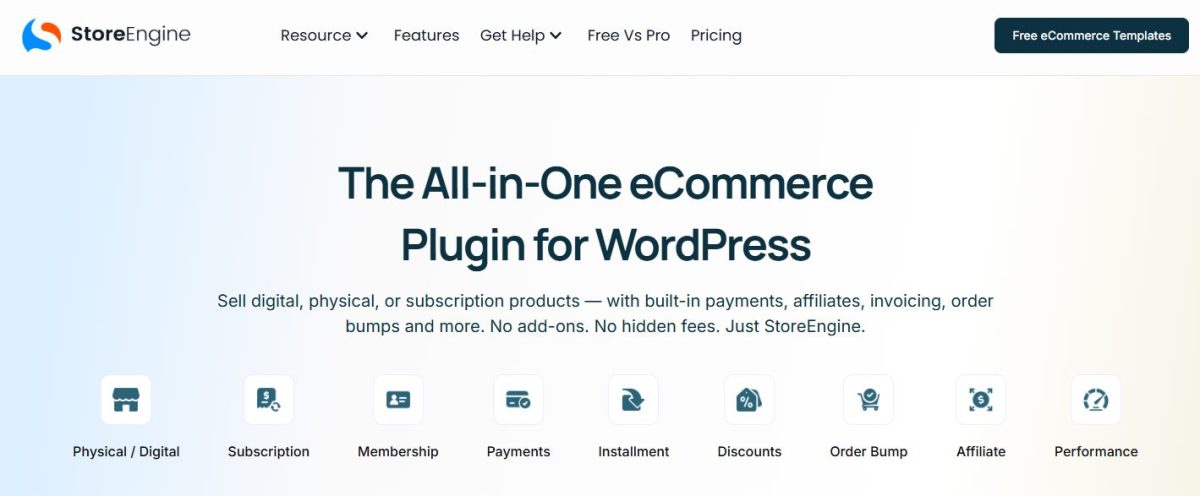
🥇 1. StoreEngine — Best All-in-One WordPress eCommerce Plugin
Best for: Sellers who want a complete, lean, future-ready eCommerce solution without the plugin sprawl.
Here’s a scenario most WordPress store owners know too well: you start with WooCommerce, then add a subscriptions plugin, then an affiliate plugin, then an invoicing plugin, then a membership plugin — and before you know it, you’re managing 12 plugins, dealing with constant conflicts, and your site loads like it’s on dial-up.
StoreEngine was built as the direct answer to that mess. It’s a true all-in-one WordPress eCommerce plugin designed to handle payments, memberships, digital sales, subscriptions, affiliates, invoicing, and order bumps inside a single, cohesive system.
No hidden fees. No patchwork extensions. No plugin conflicts are eating your site alive.
What you can sell with StoreEngine:
Physical products (with inventory and shipping)
Digital/downloadable products (secure delivery)
Subscriptions (recurring billing)
Memberships (content restriction with paid access)
Online courses (via native Academy LMS integration)
Built-in payment gateways — no extra plugins needed:
Stripe (credit/debit cards)
PayPal
Bank Transfer
Cash on Delivery
Check Payments
Standout features include: Built-in affiliate system, discount coupons with granular controls (per product, per user, with expiry), Direct Checkout for frictionless purchases, Order Bumps to increase average order value, Admin Order Creation, Tax Management, Refund Support (full or partial), Catalog Mode, One-Click Page Restore, Invoicing, and native Academy LMS course sales integration.
The plugin is also built to be Core Web Vitals friendly — its architecture avoids the script-piling that makes plugin-heavy stores crawl. Pairs beautifully with aBlocks for high-performance Gutenberg-based storefronts.
✅ Pros
Genuinely all-in-one — memberships, subscriptions, affiliates, invoicing, and more are native features.
No transaction fees on any plan
Performance-first architecture — built for Core Web Vitals compliance
Sells physical, digital, subscription, membership, and course products from one dashboard
The built-in affiliate system eliminates the need for a separate affiliate plugin.
Free version available to get started with no risk
Actively developed — frequent updates with new features (Source: storeengine.pro/whats-new/)
Academy LMS integration for course creators who want to sell learning products
Budget-friendly lifetime deal options — one payment, no annual renewal stress
❌ Cons
Newer to the market compared to WooCommerce, with a smaller third-party ecosystem
Some advanced features (product variations, inventory sync, related products) are still in development.
Smaller community size than WooCommerce, so fewer third-party tutorials are available yet
💰 Pricing: StoreEngine offers a free plan, with Pro plans starting from $99/year.
Why it wins: Most e-commerce plugins sell you a foundation and then charge you for every room. StoreEngine gives you the whole house and keeps building it.
🥈 2. WooCommerce — The Established Powerhouse
Best for: Developers, agencies, and merchants who need a massive third-party ecosystem and maximum flexibility.
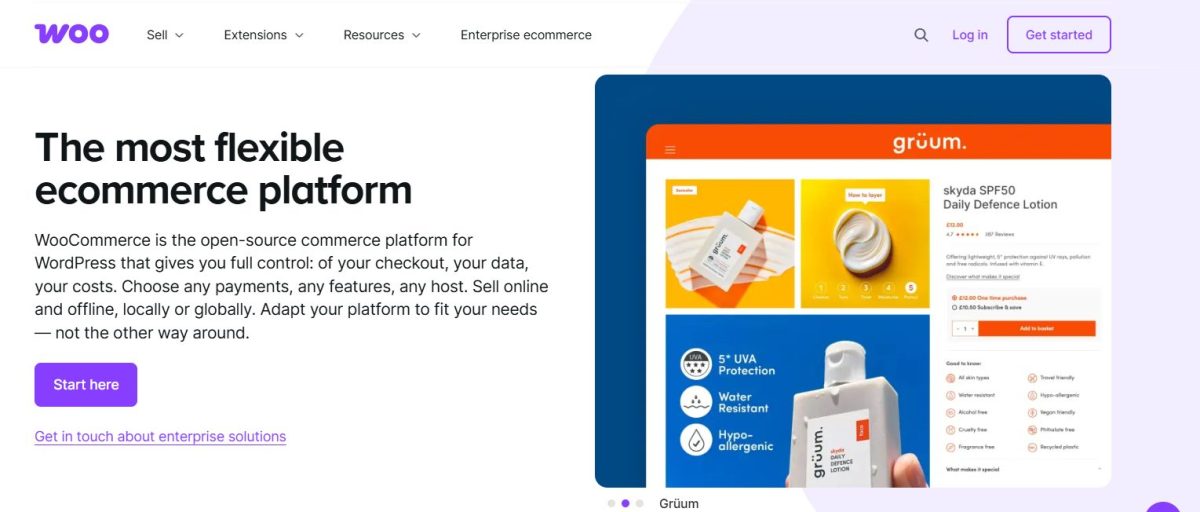
WooCommerce is the name everyone recognizes, and for good reason. Store Leads reports live WooCommerce stores, and WordPress.org shows over 7 million active installations. That’s an ecosystem so large it’s virtually its own internet.
WooCommerce is free to install and deeply flexible. You can sell physical goods, digital products, subscriptions, rentals, bookings, memberships, the list genuinely goes on. It integrates with almost every payment gateway ever built, and there are thousands of themes and extensions tailored specifically for it.
If you’re an agency building stores for clients or a developer who needs total customization freedom, WooCommerce is the Swiss Army knife of WordPress eCommerce. But — and this is a substantial but — it is a foundation, not a finished store. Extensions for subscriptions, advanced shipping, multi-currency, and checkout optimization are all separate purchases that compound quickly.
✅ Pros
Most extensively used WordPress eCommerce plugin in the world — massive community.
Enormous third- party ecosystem( themes, extensions, integrations)
Sells nearly every product type — physical, digital, subscriptions, bookings, settlements
Integrates with nearly every payment gateway
100 open-source — full control over law and data
Thousands of free and paid themes designed specifically for WooCommerce
expansive inventor attestation and community support
❌ Cons
The” free” marker is deceiving — WooCommerce Subscriptions alone cost $50 – $150 time, and Table Rate Shipping costs$ 99/ time.
Startups generally spend between $50 –$ 100/ month on WooCommerce; large stores can spend $3,000/ month depending on business and tools.
Installing numerous extensions can significantly decelerate your point of a real SEO and conversion threat
No erected- in chapter system, invoicing, or order bumps all bear paid add-ons
💰 Pricing: WooCommerce offers a free plan, with Pro plans starting from $50 – $150/year
🥉 3. Easy Digital Downloads (EDD) — The Digital Seller’s Specialist
Best for: Creators selling digital products exclusively — software, ebooks, music, templates, plugins.
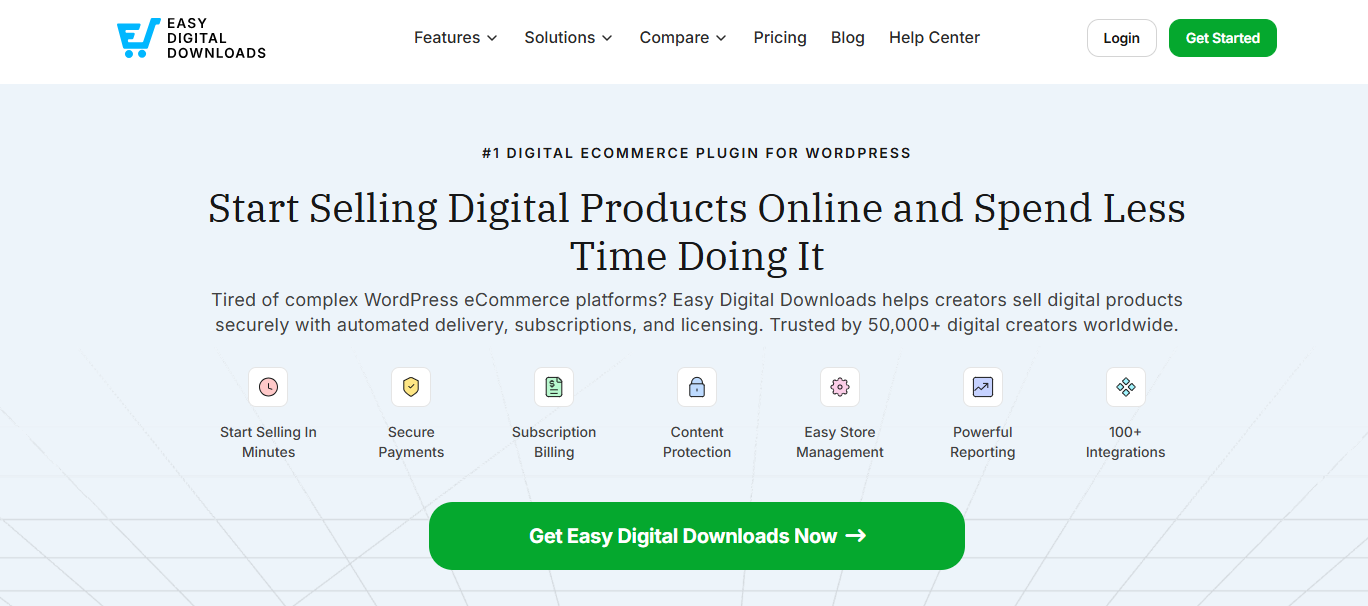
Easy Digital Downloads does one thing and does it exceptionally well to sell digital files. However, EDD’s ray focus is a genuine asset rather than a limitation if your store will not transport a physical product.
The experience is remarkably clean. Adding a new product feels exactly like writing a WordPress blog post — enter a title, upload your train, set a price, and you’re done. For digital-only businesses, that simplicity is hard to beat.
EDD integrates natively with Stripe, PayPal, and Apple Pay, tracks every download, manages client purchase history, and handles software licensing for inventors. The interface is intuitive enough that, indeed, first-time WordPress users can navigate it with minimum frustration.
The wise side? The moment you want to expand into physical goods, enrollments, or subscriptions without paying for extensions, EDD starts to show its limits. The core plugin is free, but the meaningful features come with paid passes that some druggies find precious.
✅ Pros
Laser-focused on digital products — cleaner and lighter than general-purpose plugins
Excellent download tracking and detailed customer purchase history
Strong software licensing support for plugin and software sellers
Integrates natively with Stripe, PayPal, and Apple Pay
Zero transaction fees
A large community of digital product sellers and developer resources
All-access passes bundle every extension into one annual subscription.
❌ Cons
No support for physical products — a hard wall for mixed-product stores
Subscriptions, memberships, and advanced marketing require paid extensions.
EDD pricing starts at $99 annually for the Personal plan, once you move beyond the limited free version
Smaller ecosystem compared to WooCommerce — fewer integration options.
No built-in affiliate system
No invoicing or order bump features natively.
💰 Pricing: Easy Digital Downloads offers a free plan, with Pro plans starting from $99/year.
4. BigCommerce for WordPress — The Headless Enterprise Option
Best for: High-volume merchants who want enterprise-grade commerce performance while keeping WordPress for content.
BigCommerce for WordPress takes a fundamentally different approach. Rather than running eCommerce through WordPress itself, it operates as a headless architecture — your WordPress site handles all your content and SEO, while BigCommerce’s powerful backend engine processes the actual commerce: catalog, checkout, payments, and inventory.
The result is exceptional performance. The commerce layer is hosted separately on BigCommerce’s infrastructure, meaning your WordPress site isn’t bogged down by complex checkout scripts. For high-traffic stores moving serious volume, this separation delivers meaningful speed and reliability gains.
BigCommerce charges zero transaction fees if you use one of its 65+ pre-integrated payment gateways — a real advantage over competitors that clip a percentage of every sale.
The catch is cost and complexity. BigCommerce is a paid SaaS platform on top of your existing WordPress hosting costs, and the headless setup requires developer involvement for anything beyond a basic integration.
Zero transaction fees on all plans with pre-integrated payment gateways
Enterprise-grade catalog management, multi-currency, and multi-channel selling are built in.
Advanced B2B features are available.
Strong uptime and security are handled at the platform level.
No plugin conflicts — the commerce engine is entirely separate from WordPress.
❌ Cons
Starts at $39/month (Standard) — no free tier available
Requires developer expertise for proper headless setup — not beginner-friendly
Monthly SaaS fees on top of your WordPress hosting costs mean a higher baseline spend.
Sales volume caps per plan — once exceeded, you’re automatically upgraded to a higher tier.
Less flexible customization within WordPress compared to native plugins
Smaller community of WordPress-specific BigCommerce users
💰 Pricing: BigCommerce offers Pro plans starting from $39/ per month.
5. Ecwid by Lightspeed — The Multi-Channel Embedder
Best for: Small businesses and solo sellers who want to add a store to an existing WordPress site without rebuilding anything.
Ecwid takes the most unconventional approach on this list. Instead of replacing or deeply integrating with WordPress, it embeds a fully functional store as a widget into any existing site. You paste a snippet, and your products appear — no migration, no rebuild, no disruption to what you’ve already built.
The free plan supports up to 5 physical products. The Venture plan at $25/month expands to 100 products and adds digital goods, discount coupons, and inventory tracking. It also syncs across multiple channels — Facebook, Instagram, Amazon, eBay — making it a compelling pick for sellers who live on social commerce.
The tradeoff is control. Because Ecwid is a hosted solution, your store data lives on Ecwid’s servers, not your own WordPress installation. SEO flexibility is limited compared to native WordPress plugins. And design customization is constrained by the widget model — you can’t fully shape the store experience the way you can with WooCommerce or StoreEngine.
✅ Pros
Embed-anywhere approach — works on WordPress, Wix, or any HTML site without rebuilding.
Free plan available (up to 5–10 products depending on version)
Multi-channel selling across Facebook, Instagram, Amazon, and eBay out of the box
No transaction fees on any plan
Clean, fast setup — genuinely beginner-friendly
Mobile-responsive by default
Affordable entry-level paid plans
❌ Cons
Store data lives on Ecwid’s servers — you don’t fully own it the way you do with WordPress-native plugins.
SEO is less flexible and less powerful than WooCommerce or StoreEngine
The free plan’s 10-product limit is a real constraint for growing stores.
Product variants and filters are locked behind Business or Unlimited plans.
Design customization is limited by the widget architecture.
Ecwid apps are relatively expensive for additional features.
Pricing for paid plans was updated in March 2026 to confirm current costs before committing.
💰 Pricing: Ecwid offers a free plan, with Pro plans starting from $5 per month.
Head-to-Head Comparison Table
Features
StoreEngine
WooCommerce
EDD
BigCommerce
Ecwid
Starting Price
Free
Free
Free (limited)
$39/month
Free (limited)
Physical Products
✅
✅
❌
✅
✅
Digital Products
✅
✅
✅
✅
✅ (paid plan)
Subscriptions
✅ Built-in
💲 $50 – $150yr addon
💲 Addon
✅
💲
Memberships
✅ Built-in
💲 Addon
💲 Addon
❌
❌
Affiliate System
✅ Built-in
💲 Addon
💲 Addon
❌
❌
Invoicing
✅ Built-in
💲 Addon
💲 Addon
✅
❌
Order Bumps
✅ Built-in
💲 Addon
❌
❌
❌
Transaction Fees
None
None
None
None
None
Data Ownership
✅ Self-hosted
✅ Self-hosted
✅ Self-hosted
⚠️ Hybrid
❌ Hosted
Performance-First
✅
⚠️ Variable
✅
✅
✅
LMS Integration
✅ Academy LMS
💲 Extension
❌
❌
❌
Beginner-Friendly
✅
⚠️ Moderate
✅
❌ Needs dev
✅
Common Mistakes When Choosing a WordPress eCommerce Plugin
Mistake# 1: Going with the most popular option by default. Fashionability means a large stoner base, not the stylish fit for your specific model. The right tool solves your problem most efficiently.
Mistake# 2: Ignoring the total cost of power. A” free” plugin with $400/ time in needed extensions is not free. Always calculate the full bill, not just the caption price.
Mistake# 3: Undervaluing performance impact. Every fresh plugin adds weight. A slow store hurts your Core Web Vitals, drops your Google rankings, and costs you conversions before a caller indeed reads your product description.
Mistake# 4: Not testing before committing. Most plugins offer free performances or trials. Use them before you resettle your roster, configure payments, and invest hours in setup.
Mistake# 5: Choosing a plugin with weak support. You’ll need help ultimately. Choose a plugin backed by a platoon that responds snappily, maintains attestation, and takes bug reports seriously.
The Bottom Line
Picking an eCommerce plugin isn’t just a technical decision — it’s the architectural choice that shapes your checkout experience, your SEO rankings, your ability to run promotions, manage customers, and scale without friction.
In 2026, the market will be crowded. But the right answer for most WordPress store owners, especially those who want serious power without complexity or a growing annual tab from extension fees, is increasingly clear.
StoreEngine gives you everything you need to sell digital products, physical goods, subscriptions, memberships, and courses — with built-in affiliates, invoicing, direct checkout, and order bumps — all inside one plugin that won’t slow your site down.
It’s not trying to be everything to everyone. It’s trying to be exactly what modern WordPress sellers actually need: a fast, complete, affordable store engine that gets out of your way and lets you sell.
Help & Support
Frequently Asked Questions (FAQs)
Quick, clear explanations to help you use AffiliateX with confidence.
01
Do I need rendering chops to use a WordPress eCommerce plugin?
Not inescapably. Ecwid and StoreEngine are designed for non-technical users. WooCommerce and EDD bear some WordPress familiarity but no coding. BigCommerce for WordPress headless setups still bear inventor involvement.
02
What is the stylish WordPress eCommerce plugin for dealing with digital products?
Both StoreEngine and Easy Digital Downloads handle digital products well. StoreEngine has the edge if you also want enrollments, subscriptions, or courses in the same plugin — no add-ons demanded.
03
What is the most affordable option for a brand-new store?
StoreEngine’s free league and Ecwid’s free plan are both solid starting points. StoreEngine has a stronger upgrade path because it stays tone- hosted and adds more native features as you grow.
04
Is WooCommerce really free?
The core plugin is. But a real WooCommerce store generally costs $50 –$ 100/ month once you factor in essential extensions, decoration themes, and decent hosting.
05
<strong>Can I switch eCommerce plugins later? </strong>
Technically, yes, but virtually it’s painful — migrating product data, client records, and order history is time- consuming and error-prone. Get it right the first time.
06
<strong>What is the difference between an eCommerce plugin and a runner builder?</strong>
A runner builder( like Elementor or aBlocks) controls how runners look. An eCommerce plugin controls how your store functions — product operation, checkout, payments, and orders. You generally need both, which is why plugins that integrate fairly with builders matter.
Afrin is a skilled Product Marketing Specialist passionate about WordPress products. She effectively combines her background in Telecommunication Engineering and her MBA in Marketing to bridge technology and marketing. Afrin transforms technical WordPress features into compelling, user-centric content that drives conversions and fosters engagement. In her free time, she enjoys traveling, animated movies, and singing, reflecting her creativity and adventurous spirit.