
10 Affiliate Marketing Statistics You Need to Know to Grow in 2026

Affiliate marketing has become an essential revenue-generating tactic for businesses and creators, offering a performance-based approach with the flexibility to scale. By focusing on high-demand niches and optimizing your content for both search engines and mobile users, you can tap into the expanding market and create a sustainable income stream.
Embracing multi-channel strategies, including blogs, social media, and video platforms, allows you to reach a broader audience and increase your affiliate success. The affiliate marketing statistics and strategies shared here will help you maximize its potential and pave the way for long-term growth and profitability.
Why Affiliate Marketing Still Matters in 2026
Source: Optinmonster
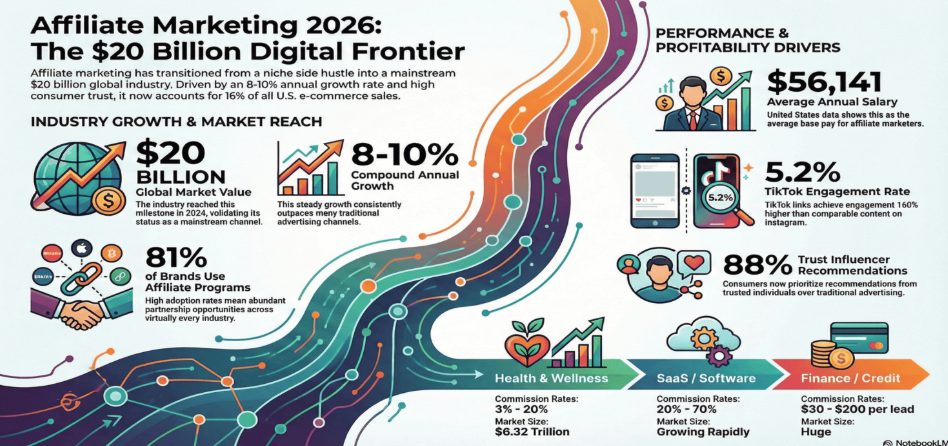
Affiliate marketing is a major growth channel for brands and creators. The industry is projected to reach $20 billion in 2026 and $71 billion by 2034, growing steadily at 15% annually. With over 80% of brands running affiliate programs, businesses now consider affiliates a mainstream strategy.
However, this also signals significant scope for solopreneurs, bloggers, and content creators. And the key is to pick the right niche, content format, and audience. You are not competing. All you are doing is stepping into a space where demand for trustworthy recommenders continues to rise each year.
1. Low‑risk, high‑scalability model
Affiliate marketing lets you start with little money. You don’t need inventory, a warehouse, or your own product. All you need is a way to reach people. This could be a blog, a YouTube channel, social media pages, or a mix of these. Brands pay you only when someone makes a sale or generates a lead. You do not risk your cash on ads; you earn from the traffic you have or can grow.
This performance-based model is also why businesses are eager to invest in affiliates. Reports show that using affiliate partners can drive 20–40% of new customers for some industries. Brands often see $10–15 in return for every $1 they spend on affiliates. Those returns make affiliate marketing a “must-have” channel. It is not just a nice-to-have experiment in 2026.
2. Your audience is your real asset
One of the biggest advantages for solopreneurs is access to their audience. If one affiliate program changes its terms, you can usually switch to another similar offer. You will not lose your traffic or followers. That kind of flexibility is harder to get with freelancing or agency work. There, losing one client can wipe out a big chunk of your income at once.
In 2026, creators who focus on authentic, value-driven content stand out. Product comparisons, honest reviews, “best X for 2026” lists, and problem-solving tutorials are what brands want. When your audience trusts you, they are more likely to click your links and buy products. They even keep coming back to your site for future recommendations. That trust turns a simple blog or channel into a long-term, semi-passive income stream.
3. Great opportunity for solopreneurs, bloggers & creators
If you are a blogger, YouTuber, or social media creator, affiliate marketing fits naturally into how people use the internet. Research shows that a large share of consumers visit many sites and read reviews before buying. This means they are actively seeking trusted recommendations. By positioning yourself as a trusted guide and using affiliate links where it makes sense, you can monetize their buying behaviour. You do this without being too salesy.
For solopreneurs, 2026 is a good time to lean into research-intensive niches such as software, AI tools, e-learning, health, and finance. These categories have fast-growing affiliate programs. Even starting from zero, you can build a small site or channel around a focused niche. You can create content that ranks in search engines and gradually grow a steady stream of affiliate income over time.
4. SEO & AIO‑friendly growth angle
Search engines still send lots of traffic to review‑style and “best in 2026” content, which is why blogs and long‑form articles remain one of the top channels for affiliates. When you write clear, helpful posts that answer real questions, not just drop links, you increase your chances of ranking and earning commissions for months or even years without extra effort.
Using an SEO / AIO plugin (like All in One SEO) lets you track affiliate links, optimize titles and meta descriptions, and add structured data that search engines understand, which in turn boosts your visibility and click‑through rate. Combined with clean internal linking, mobile‑friendly design, and fast loading speeds, this approach makes affiliate content feel natural and professional, not spammy.
Affiliate marketing matters in 2026 because demand is rising, brands are investing heavily, and entry barriers are low for those who create valuable content. The opportunity is not just to make money online, but to build a sustainable, audience-driven business as affiliate marketing grows.
10 Affiliate Marketing Statistics You Need to Know to Grow in 2026
As affiliate marketing continues to evolve and expand, staying up to date with the latest statistics is essential for businesses and marketers looking to thrive in 2026. More brands are relying on affiliate programs as a core part of their digital marketing strategies. The impact of this performance-based channel is undeniable. These key affiliate marketing statistics will give you valuable insights into the industry’s growth and help you make smarter decisions to drive your business forward.
Stat 1: Global Market Size: Affiliate Marketing to Reach Over $20 Billion in 2026
The global affiliate marketing industry is projected to grow to $20 billion in 2026 and $71 billion by 2034, growing steadily at 15% annually. This demonstrates a consistent upward trend in the sector’s growth, highlighting brands’ worldwide increasing reliance on affiliate marketing.
Why it matters
This growth reflects the increasing importance of affiliate programs in digital marketing strategies. The industry’s continued expansion underscores the growing value of affiliate marketing as an essential tool for online success.
Stat 2: U.S. Affiliate Spending: Forecasted $13.2 Billion in 2026
U.S. affiliate marketing spending is set to reach $13.2 billion by 2026, a significant 10.1% year-over-year increase. This sharp rise in spending points to how affiliate marketing has become a driving force in the U.S. digital marketing industry.
Why it matters
Affiliate marketing continues to prove its value as a scalable, cost-effective solution for businesses. With such impressive growth figures, it’s clear why more brands are turning to affiliate marketing to grow their revenue in the U.S.
Stat 3: Affiliate Marketing Adoption – 81% of Brands Use It
A staggering 81% of brands are using affiliate marketing as a core digital marketing strategy. This statistic shows that affiliate marketing has become a mainstream tool in companies’ digital marketing toolkits worldwide.
Why it matters
Affiliate marketing isn’t a side project anymore; it’s an integral part of mainstream marketing. For businesses looking to remain competitive, embracing affiliate marketing is now a must.
Stat 4: Global Industry Value Range: $17 Billion–$20 Billion in 2026
Some projections estimate that the affiliate marketing industry will be valued between $17 billion and $20 billion in 2026, indicating a healthy, consistent rise in the market.
Why it matters
This wide range of estimates suggests the growth potential of affiliate marketing could vary across markets. However, it’s clear that the industry is on an upward trajectory, highlighting its sustained relevance and profitability.
Stat 5: E-commerce Influence: 16% of U.S. Online Orders Are Affiliate-Driven
Affiliate marketing accounts for about 16% of all online orders in the United States, underscoring its crucial role in shaping e-commerce sales.
Why it matters
Affiliate marketing isn’t just an add-on to online businesses; it’s a critical driver of sales. For e-commerce brands, affiliate marketing is a proven way to expand their reach and boost revenue.
Stat 6: Business Adoption (Advertisers): 84% of Brands Have Affiliate Programs
An impressive 84% of brands currently use affiliate programs, making it one of the most widely adopted digital marketing methods.
Why it matters
With the majority of brands running affiliate programs, it’s clear that affiliate marketing has become a trusted strategy. Businesses are increasingly recognizing its ability to generate sales without upfront costs, making it a preferred choice.
Stat 7: Affiliate as Main Income (Publishers): 31% of Web Publishers Rely on It
Around 31% of web publishers rely on affiliate marketing as their primary source of income, underscoring its vital role for content creators and bloggers.
Why it matters
Affiliate marketing offers a flexible and scalable income stream for publishers. With many content creators earning through affiliate links. It’s no wonder that more are adopting it as their primary business model.
Stat 8: ROI of Affiliate Marketing: 12:1 Return on Investment
Affiliate marketing delivers an average ROI of 12:1, making it one of the highest-performing digital marketing channels.
Why it matters
For businesses, the 12:1 ROI ratio means that for every dollar spent on affiliate marketing, they can expect to earn $12. This high return makes affiliate marketing an attractive and cost-effective strategy for businesses of all sizes.
Stat 9: Affiliate Contribution to Brand Revenue: 65% of Marketers Report 20% Revenue
65% of affiliate marketers claim that their affiliate programs generate at least 20% of company revenue, underlining the significant financial impact of affiliate marketing on business growth.
Why it matters
This statistic shows how powerful affiliate marketing can be in driving revenue. For many brands, affiliate programs have proven to be a consistent source of substantial income.
Stat 10: High Commission Niches: SaaS Affiliate Programs Offer 20–70% Commissions
SaaS affiliate programs offer some of the highest commission rates in the industry, ranging from 20% to 70%, making them highly attractive for marketers.
Why it matters
SaaS products are known for their recurring revenue models, which often lead to high commissions for affiliates. These lucrative rates make SaaS programs a top choice for affiliate marketers looking to maximize earnings.
Stat 11: Amazon Associates Market Share: Dominates Affiliate Marketing with 46.21% Market Share
Amazon Associates remains the largest affiliate network, holding a 46.21% market share of global affiliate marketing revenue.
Why it matters
As the most widely recognized and trusted affiliate program, Amazon Associates offers a diverse range of products for affiliates to promote, making it the go-to choice for many marketers. Its dominance underscores the strength of affiliate marketing in global commerce.
How to Apply These Affiliate Marketing Stats in 2026
Affiliate marketing is no longer a “nice to have” tactic. It’s now a core revenue-driven work for brands and creators alike. The statistics you just explored tell us one thing clearly: grow in 2026. You must be strategic, data‑driven, and adaptable in how you leverage affiliate trends. Below are practical, step‑by‑step ways you can put those insights into action this year and beyond.
1. Choose 1–2 High‑Earning Niches That Match Your Strengths
To be successful in the affiliate marketing sector in 2026, focus your efforts and don’t scatter them. The data shows that certain niches consistently outperform others because they have large audiences and strong purchase intent. Examples include:
- E‑Learning & Online Education: People are constantly seeking skills and certification. Courses, tools, and membership platforms offer high‑value conversions.
- SaaS & Software Tools: These programs often offer recurring commissions and high payout percentages (like 20–70% on sign‑ups).
- Local Services: Evaluating affiliate recommendations for your city or region, such as local flower delivery and home services, can capture high‑intent buyers with less competition.
How to apply
Start with what you know. Pick one niche where you have expertise, whether it’s tech tools, personal finance apps, fitness programs, or lifestyle products, and one that resonates with your audience’s interests. By narrowing your focus, you naturally optimize content relevance and visitor trust, which in turn leads to higher conversion rates.
2. Build a Mobile‑Optimized, SEO‑First Website
Statistically, search engines and mobile users are driving the majority of affiliate conversions. People don’t click on affiliate links randomly. They search for answers, comparisons, and reviews with the intent to buy.
What this means in practice
- Mobile Optimization is Non‑Negotiable: More than half of all web traffic comes from mobile devices. If your site loads slowly or isn’t responsive, you will lose readers and affiliate clicks before they convert.
- SEO‑First Structure: Use keyword research tools to find high‑intent terms like “best antivirus software 2026,” “top e‑learning platforms,” or “local gift delivery services near me.” Then build structured content around those terms.
- Long‑Form & Review‑Based Pages: Longer content (1,500+ words) performs better because it answers more user questions and ranks higher in search engines. Reviews and comparisons build trust, help users make decisions, and naturally lead to affiliate clicks.
3. Combine Blog, YouTube & Reels/Shorts Around the Same Keywords
In 2026, valuable content isn’t confined to one format. Users switch seamlessly between search, video, and social. Data shows that multi‑format strategies increase visibility and drive more affiliate revenue.
How to do it right
- Blog Posts for SEO: Your long‑form articles act as the foundation for search traffic.
- YouTube Reviews & Tutorials: Recreate the same topics in video form. Embed these videos in your blog for longer time‑on‑page (excellent for SEO) and additional monetization.
- Short‑Form Reels/Shorts: Create bite‑sized, engaging visual content for TikTok, Instagram, and YouTube Shorts that link back to your blog or full video review.
How to Leverage Affiliate Marketing for Long-Term Success
The future of affiliate marketing is bright, and the stats in this blog highlight why now is the time to take action. With over 80% of brands adopting affiliate marketing and the industry’s market share escalating, the revenue potential is immense. By focusing on high-earning niches, optimizing your website for mobile and SEO, and utilizing multi-platform strategies like blogs, YouTube, and social media, you are not just following trends. You are setting yourself up for sustainable success.
As the industry continues to evolve, applying these strategies will ensure that you stay ahead of the curve and reap the benefits of affiliate marketing in 2026 and beyond. If you want to read more strategic content, don’t forget to follow our blog posts and our YouTube channel.